As almost every jatra celebrated in the Kathmandu Valley has a fascinating backstory, the Indra jatra does as well. Though the viewpoint behind commemorating Indra Jatra varies from place to city.
The Indra jatra in Kathmandu shows a thematically connected succession of many settings. At the very least, the installation of a towering pole, the Kumari jatra, lakhey dance, entertainment related to Lord Bhairava, and the tradition of the funeral procession.
But, that somehow seems previously endured in Bhaktapur being a specific event. For instance, the towering thing is performed in Biska Jatra. The ritual of the death procession happens in Gai Jatra. Kumari procession befalls in Mohani (Dashain) including various acts and masked dances.
Perhaps, that’s why the Indra Jatra is often overlooked in Bhaktapur. Instead, within those eight days, some minor and moderate events befall in Bhaktapur. That acceptably is believed as the interval of Indra Jatra. Though, it has very fewer relations with Lord Indra.
Bhaktapur, however being the city of festivals holds a very petty portion of the Indra Jatra in it. In which, mainly the four occasions appear in the span, including Yenya Punhi. Pulu Kisi
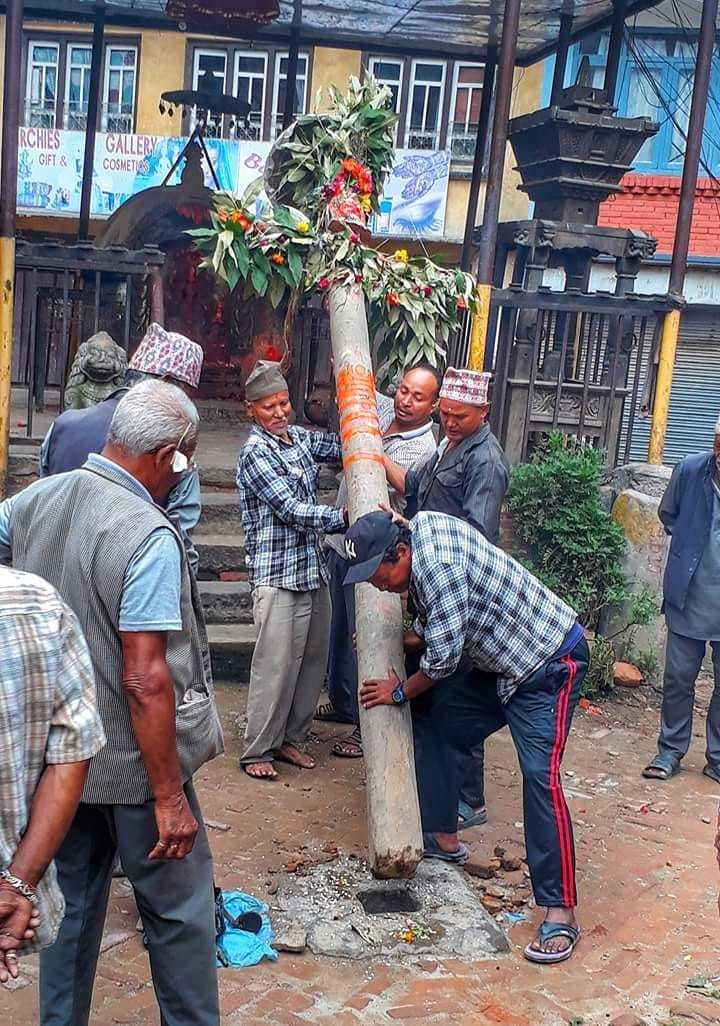
The Yama Dya; Thanigu begins the first day of the celebration. Where a pole is placed at several places or toles of Bhaktapur, definitely indicating the god of death, Yama. People frequently travel there to worship it from then till the conclusion of the jatra season. Presuming that it will protect the locals from death.
Devotees attend various Narayan temples on the third day of the procession because it is also Ananta Narayan Puja day. The significance of this day is equal to that of Tulsi sowing day for Narayan worshipers.
Furthermore, the same day hereabouts sees the Indrayani Jatra, in which Goddess Indrayani is worshiped and paraded as Lord Indra’s consort rather than one of the Astamatrikas. The idol of Indrayani is also carried from its dyo;chhen, or God House, for the procession and paraded throughout the entire city in a procession.
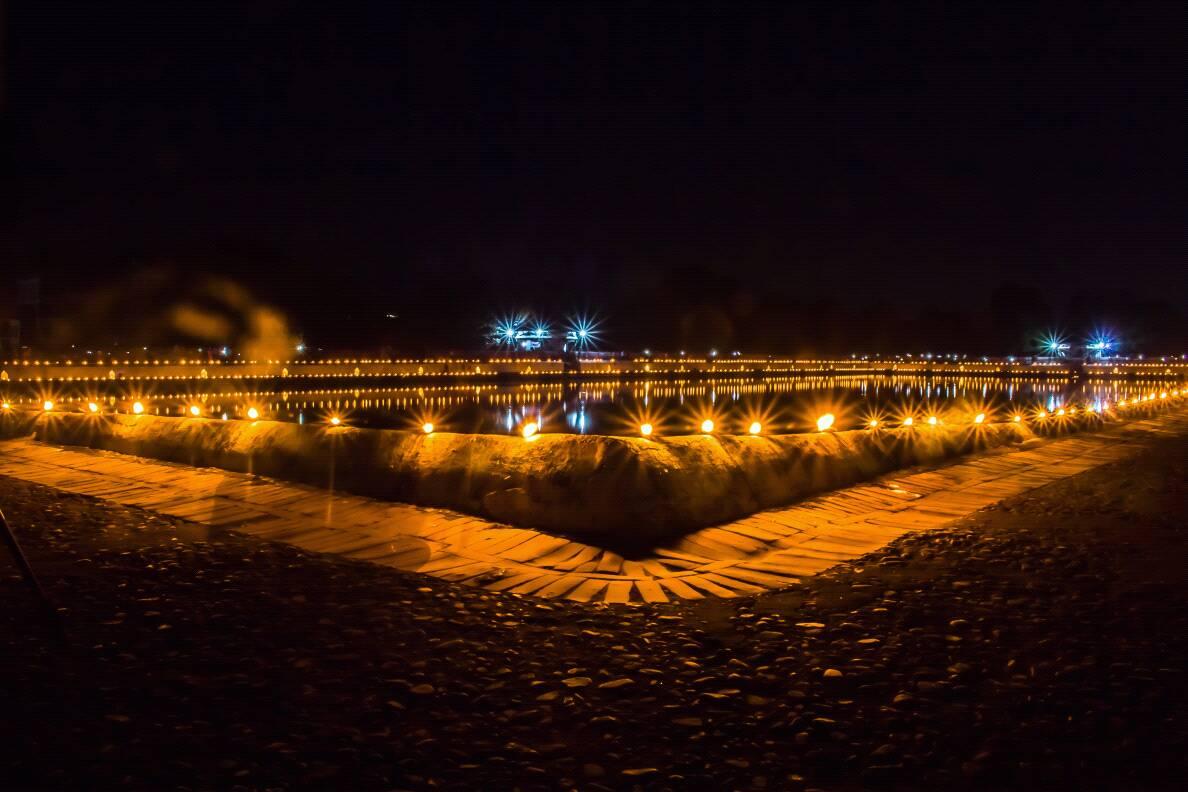
Foremost the procession ends at the biggest manmade pond of Bhaktapur named Ta: Pukhu (Shiddhapokhari). It used to be called Indra Daha in ancient times.
Now, at the very end of the day, the statue of the Indrayani is left over there, overnight in an open building, a phalcha.
The following day of the Indrayani Jatra is Yen; ya punhi. That is known as the You Dya; Punhi in Bhaktapur. It is also the day of the Shiddhapokhari Mela. Devotees, usually from nearby villages, gather to bathe in the pond. They also worship the image of Indrayani, which is afterward restored to its deity home.
Two ceremonies take place on the last day of the Indra jatra festival. The first is Samsana Bhailadya Jatra, which is unrelated to the topic of Indra Jatra. Nonetheless, it reflects the connections between Yama and death.
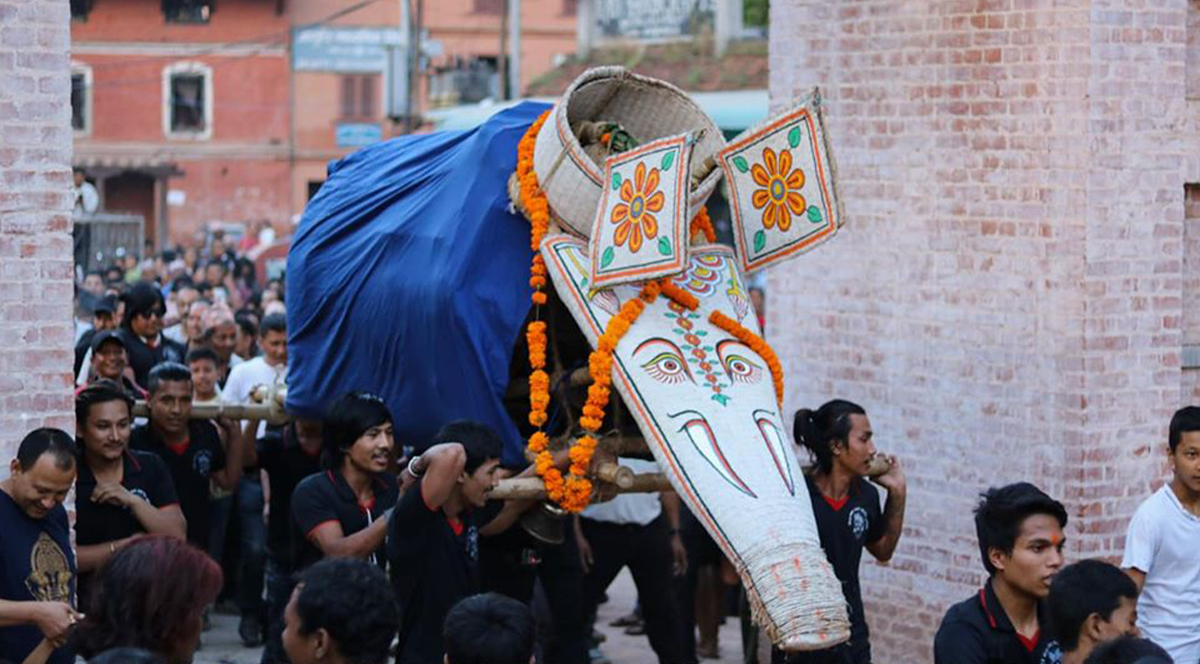
Second, the act of Pulu Kisi haigu. It symbolizes the conclusion of this collection of tales. During this occasion, the Pulu Kisi behaves rudely, as though it is there to cause problems. However, there is one more rumor airing around the air.

According to legends, a demonic entity named Mupatra, Lord Indra’s enemy, emerges to pay respect to the Yama dyo at Indra Jatra. Although this scenario occurs rarely nowadays, if these two characters (Mupatra and Pulu Kisi) manage to cross paths during Mupatra’s visit, a severe battle might ensue, with the Mupatra suffering the most.
Moreover, the Pulu Kisi procession begins at Lakulachhen and extends all the way to Dattatraya Square.
According to folklore, Lord Indra was once captured by a demon. As a result of something like a false charge of stealing the Parijat flower. Whereas he was only carrying out his mother’s request to bring her that flower. After then, her mother, who was unaware of the allegations, sent Indra’s vehicle (Aerawat, an elephant) to the earth to find Lord Indra.
The elephant eventually tracked him down and informed his mother of his whereabouts.
She then came to Earth right away to save him. In exchange for a boon, Lord Indra was then freed. The demon that captured Lord Indra asked for clouds and fog as a blessing. Clouds and fog are inevitable components for keeping the rice, which was the most essential thing for them at the time. Because it was rice germination season.
It is also added to the story that as the gods were on their way back to heaven, some humans left a track of grain in their route so that they might subsequently find their way back.
Mupatra in Bhaktapur: The Demon King of Indra Jatra
Mupatra is a prominent demon king in the traditional Indra Jatra celebrations of Bhaktapur. According to local mythology, Mupatra captures and punishes Jayanta, the son of Indra, after Jayanta is caught picking Parijat (coral jasmine) flowers.
In the traditional story, Jayanta comes to the human world to collect Parijat flowers. After he is caught picking the flowers, he is captured by Mupatra, the demon king, and punished.
The story is represented through the Mupatra Jatra, in which performers wearing elaborate demon masks and traditional costumes move through the historic streets of Bhaktapur. The procession brings the traditional story of Jayanta and Mupatra to life through performance and ritual.
Mupatra also has a fascinating connection with Pulu Kisi, the traditional blue elephant associated with Indra Jatra.
According to local tradition, Pulu Kisi comes in search of Jayanta after he is captured by Mupatra. Because Mupatra and Pulu Kisi represent opposing sides of the story, they are traditionally not supposed to meet during their processions.
An encounter between Mupatra and Pulu Kisi is traditionally believed to lead to a confrontation. For this reason, their procession routes and timing are traditionally managed to prevent the two from meeting.
This unusual relationship between Mupatra and Pulu Kisi adds another layer of drama and symbolism to Bhaktapur’s Indra Jatra.

Mupatra is more than a masked festival character. The figure represents an important part of Bhaktapur’s living cultural heritage, preserving a traditional story through public performance.
The Mupatra procession demonstrates how Bhaktapur’s festivals combine mythology, religion, traditional masks, costumes, storytelling, and community participation.
For visitors experiencing Indra Jatra in Bhaktapur, seeing Mupatra and understanding his connection with Jayanta and Pulu Kisi offers a deeper insight into the city’s unique festival traditions.
This 8 days long celebration usually befalls in between September and October. Sometimes, in August/September. As per the Nepalese calendar, the festival starts from the Bhadra Dwadashi and follows for seven more days.
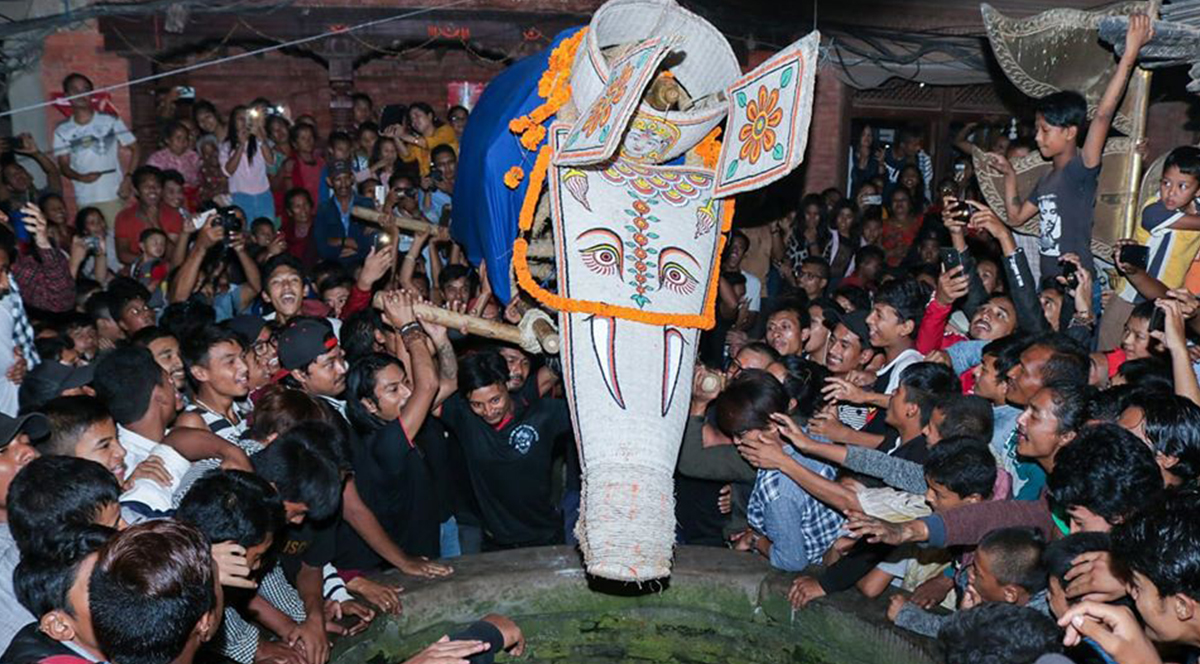
Pulukisi is a traditional elephant figure performed during Indra Jatra. In Bhaktapur, Pulu Kisi appears as a large blue elephant figure. Pulu Kisi is connected with the story of Indra’s elephant. The Pulu Kisi performance is lively and playful. As it moves through the streets, it interacts with crowds, runs after people, and creates moments of laughter and excitement.
Mupatra is the demon king who captures and punishes Jayanta (Indra’s son) after Jayanta is caught picking Parijat (coral jasmine) flowers.
Traditionally, Mupatra and Pulu Kisi are not supposed to meet during their processions. Local tradition says that an encounter could result in a confrontation, so their routes and timing are arranged to avoid it